:warning: This file is part of the "archive" – it could contain statements or terms which are incompatible with the main body of the specification and the identity and timing model. :warning:
3. Split Essence Synchronisation
Aim: Synchronise TDS 3 with TDS 4
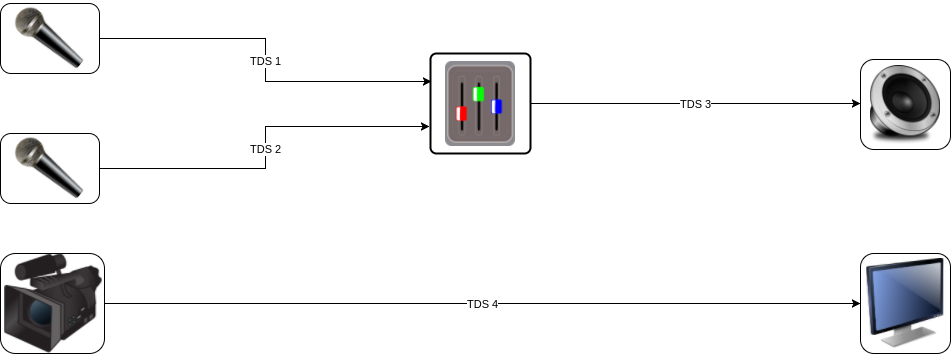
Scenario
In order to permit synchronisation of TDS 3 with TDS 4 in an automated fashion, it must be possible to relate them to each other.
Behaviour & Options
In (1), three options were presented for the production of Time Values for TDS 3.
-
TDS3'sTime Values have no recorded relationship toTDS1 andTDS2. -
TDS3'sTime Values can be related to correspondingData Objects inTDS1 andTDS2 via a fixed time offset advertised by the mixer (link scoped timing). -
TDS3'sTime Values exactly match theTime Values used inTDS1 andTDS2 where correspondingData Objects occur (end to end timing).
Assuming TDS 4 is created in the same Time Context as TDS 1 and TDS 2, it should be clear that option 1 is inappropriate.
Both options 2 and 3 provide potential means of achieving synchronisation, with the following key differences:
-
The time offsets introduced by each processing device in the chain must be identified. The sum of these offsets for a given chain (for example the audio chain) must then be used to delay the output in corresponding chains (for example the video chain) to ensure the same level of delay is applied prior to the output device.
-
The offset between the incoming
TDSTime Values and the current wall clock time must be identified at each output device (speaker and display). The largest of these values must then be set into all output devices to ensure they all delay the output ofData Objects by the appropriate time.