:warning: This file is part of the "archive" – it could contain statements or terms which are incompatible with the main body of the specification and the identity and timing model. :warning:
1. Live Synchronisation
Aim: Synchronise TDS 1 with TDS 2
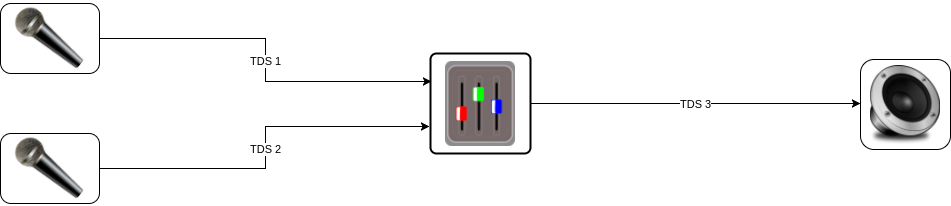
Scenario
- Two microphones are plugged into an audio mixer
- The
Time Values produced by the microphones relate to the time at which audio hit their transducers - The microphones share a timing reference (for example via PTP) and as such can produce
TDSs which useTime ContextA. - When
TDS1 andTDS2 arrive at the mixer, it can compare theirTime Values in order to mixData Objects (ie audio samples) which were coincident at the capture point of the microphones (*).
Behaviour & Options
The creation of Time Values for TDS 3 could be carried out using multiple methods:
-
If the mixer does not share a timing reference with the microphones it may create new
Time Values at its output using a differentTime Context, with no relation to the incomingTDSs. In this case the mixer producesTDSs inTime ContextB. -
The mixer may share a timing reference with the microphones but choose to create fresh
Time Values at its output. The relationship betweenTDS3 and the incomingTDS1 andTDS2 could as a result be identified via a simple time offset. In this case the mixer producesTDSs inTime ContextA. -
The mixer may select an incoming
TDSas a notional 'master' to takeTime Values from and re-use at its output. This avoids the requirement for the mixer to share a timing reference with the rest of the system, but still allows it to maintain a relationship between the inputTDSTime Values and the output. In this case there is a zero time offset betweenTDS3 and the corresponding audio samples (Data Objects) inTDS1 andTDS2. In this case the mixer producesTDSs inTime ContextA.
Caveats
- In practice the audio mixer is likely to carry out more complex processing operations which may include timing offsets. The effect that this processing has on
TDSs and theirTime Values may be explored in a later example. - (*) Audio mixers do not typically automatically compare
Time Values at their inputs and perform buffering to synchronise them. Whilst this is unlikely to change, it may be useful for future devices to indicate where mixes have been performed slightly out of sync due to the reportedTime Values. This may allow the user to impose manual delays upon the various inputs prior to the mix operation.