:warning: This file is part of the "archive" – it could contain statements or terms which are incompatible with the main body of the specification and the identity and timing model. :warning:
2. Live & File Playout Synchronisation
Aim: Synchronise TDS 2 with TDSs 3 and 4
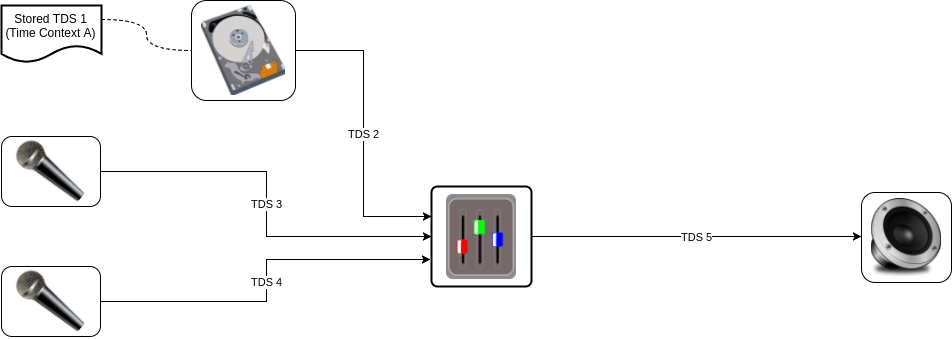
Scenario
- Two microphones and a playback device are plugged into an audio mixer
- The playback device has a stored audio
TDS1 (for example a WAV file) which consists ofData Objects andTime Values - The
Time Values in the audio recording exist withinTime ContextA which is scoped within the audio file only, with the first sample occuring at aTime Valueof zero - The
Time Values produced by the microphones relate to the time at which audio hit their transducers - The microphones and playback device share a timing reference (for example via PTP) and as such can produce
TDSs which use the sameTime ContextB
Behaviour & Options
- At the time of audio playback, a new
TDSis created by the playback device (TDS2). This contains identicalData Objects to the storedTDS1, but theTime Values are created fresh inTime ContextB to permit synchronisation with otherTDSs using thatTime Context.
Caveats
- As in (1), audio mixers do not typically automatically compare
Time Values at their inputs and perform buffering to synchronise them. - As
TDS1 is unrelated to the live signals in the system, there is little benefit in this scenario to synchroniseTDS2 withTDS3 and 4 prior to the mix. Note however that had the storedTDS1 also contained a video track which was processed by a separate chain this may have been more important. This will likely be the subject of a future application note.