JT-DMF Compute Resource Management
The JT-DMF Compute Resource Management (CRM) project provides vendors with a platform-agnostic way to declare the resources required by a Media Function.
A CRM manifest describes the compute, memory, storage, networking, accelerator, and other infrastructure resources that a Media Function needs to operate safely and predictably. The manifest is independent of any specific hardware platform, cloud provider, container runtime, or orchestration technology.
Architecture & System Model
CRM links design-time resource specification with runtime orchestration, deployment, and operational monitoring across four primary architectural tiers:
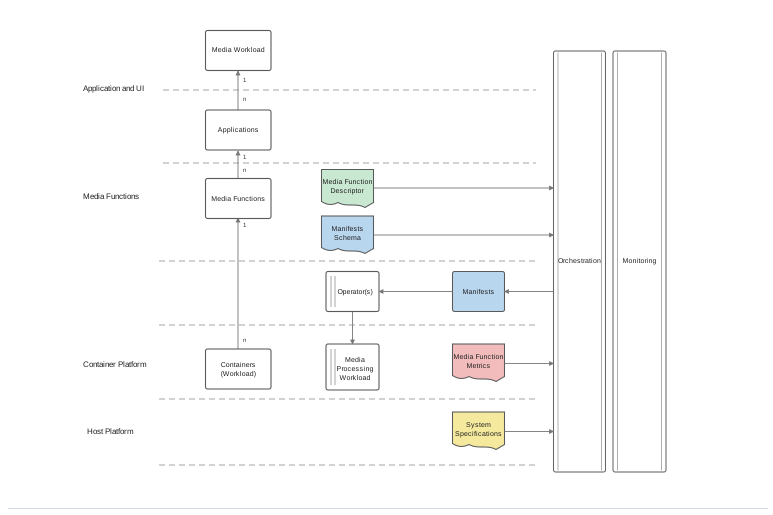
Application and UI Tier: High-level Media Workloads composed of one or more modular Applications.
Media Functions Tier: Standardizes core logic into discrete Media Functions. Defines the overall Media Function Descriptor and the primary Manifests Schema (the contract definition).
Container Platform Tier: Receives active Manifests consumed by dedicated Operator(s) to instantiate the Media Processing Workload. As the workload executes, it emits Media Function Metrics to monitor real-time performance.
Host Platform Tier: Exposes underlying physical hardware capabilities via System Specifications to inform scheduling decisions.
Orchestration & Monitoring: Cross-tier services responsible for evaluating host specifications against manifest requirements, selecting execution environments, and tracking runtime metrics.
Purpose of This Repository
The purpose of this repository is to define and demonstrate a standardized approach for creating and using CRM manifests throughout the lifecycle of a Media Function.
It provides examples and guidance for:
-
Profiling a Media Function
Observing how the Media Function uses compute, memory, storage, network bandwidth, and specialized hardware resources under representative operating conditions. -
Benchmarking its performance
Measuring the relationship between allocated resources, workload characteristics, performance, and operational limits. -
Producing a CRM manifest
Translating the profiling and benchmarking results into a portable, machine-readable declaration of the resources required by the Media Function. -
Deploying the Media Function
Demonstrating how an orchestration layer can consume the manifest, evaluate available infrastructure, select an appropriate execution environment, and deploy the Media Function with the required resources.
Intended Workflow
The repository supports the following workflow:
Media Function
      |
      v
Profile and Benchmark
      |
      v
Determine Resource Requirements
      |
      v
Produce CRM Manifest
      |
      v
Orchestration Layer
      |
      v
Validate, Place, and Deploy
      |
      v
Monitoring
This approach allows resource requirements to be based on measured behavior rather than assumptions or platform-specific deployment configurations.
Benefits
Using a standardized CRM manifest enables: - Vendors to describe resource requirements independently of the target platform. - Orchestrators to make informed placement and scheduling decisions. - Media Functions to be deployed consistently across heterogeneous infrastructure. - Infrastructure providers to validate resource availability before deployment. - Operators to achieve more predictable performance and resource utilization. - The media industry to improve interoperability between Media Functions, platforms, and orchestration systems.
Scope
This repository contains: - CRM manifest definitions and supporting models. - Example resource manifests for Media Functions. - Examples of profiling and benchmarking methodologies. - Guidance for translating benchmark results into resource declarations. - Examples showing how an orchestration layer can consume a CRM manifest. - Demonstrations of manifest-based validation, placement, and deployment.
The CRM manifest does not prescribe how an orchestration platform must be implemented. Instead, it provides a common resource description that different orchestration systems can interpret and map to their own infrastructure and deployment models.
Repository Layout
- documentation/: Supporting/legacy background material.
- manifest/: Resource manifests and schema.
- lib/: Code and submodules, including lib/mxl.
- example/: Runtime examples and deployment assets.
Real-World Deployment Patterns
Media Functions are developed by many vendors, who leverage different deployment patterns. The DMF architecture needs to support a wide range of these, minimizing the additional development cost for vendors to bring their products to DMF platforms.
Basic Media Functions involve:
- Single pod (quite commonly, and in the limit, a single container) per Media Function instance
- No Media Function-specific shared services
More complex Media Functions can have:
- Either/or:
- Multiple pods per Media Function instance
[1..N] - Multiple Media Function instances per pod, where a logical Media Function instance is an independently configured session/channel/task, with some upper bounds on the number supported by each deployed pod
[N..1] - Media Function kind-specific shared context and services (for example, asset storage)
- Media Function kind-specific cluster-wide configuration and services (for example, site license server)
Real-World Deployment Patterns
Media Function developers must be able to package their software components using their preferred virtualization technology:
- Container-based
- Recommended for resource efficiency and orchestration tooling
- VM-based
- Linux
- Windows (!)
Resource requests, limits, and claims must be applied to individual containers (or VMs):
- Logical Media Functions do not provide sufficient granularity
Proposed Domain Model
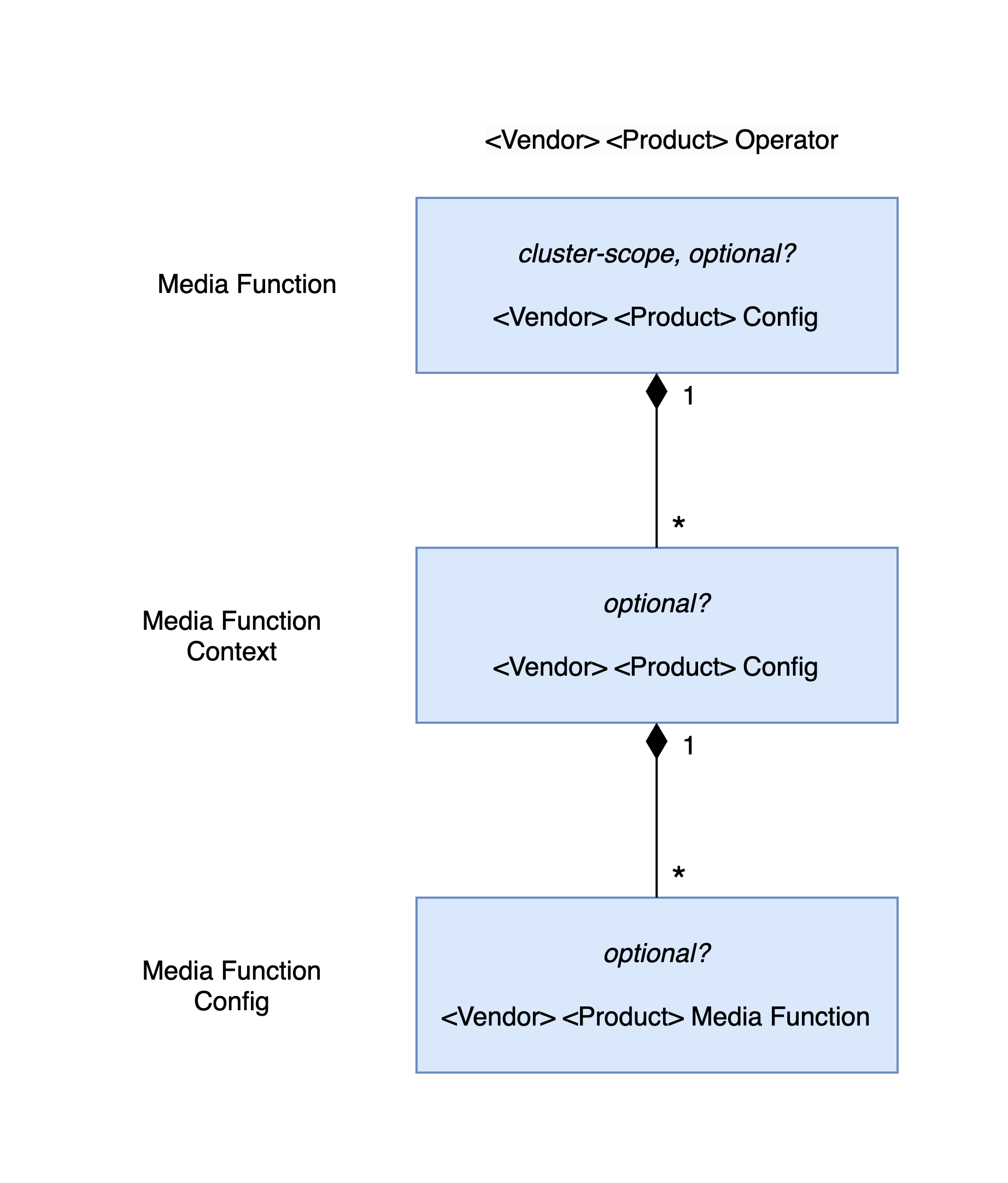
Media Function
- Represents a particular configured instance or session of a well-defined unit of functionality that produces and/or consumes a tightly coupled group of one or more live media streams.
- The particular vendor/product Media Function specification defines the input and output characteristics, such as:
- Control type (NMOS, etc.)
- Transport (MXL, etc.)
- Media format type and properties
These characteristics can be used to plan connections between compatible inputs and outputs.
Media Function Context
- Represents a management group of Media Functions that could be used to keep multiple live productions separate, for example, with separate asset storage.
Media Function Config
- Represents cluster-wide configuration and deployment of high-level components, such as a database or license server, that can or should serve multiple Contexts.
Compute Resource Management could be appropriate at any of these levels.
Reconciliation in Kubernetes
Based on: "Why Implementing Kubernetes Operators Is a Good Idea!" (Kubermatic)
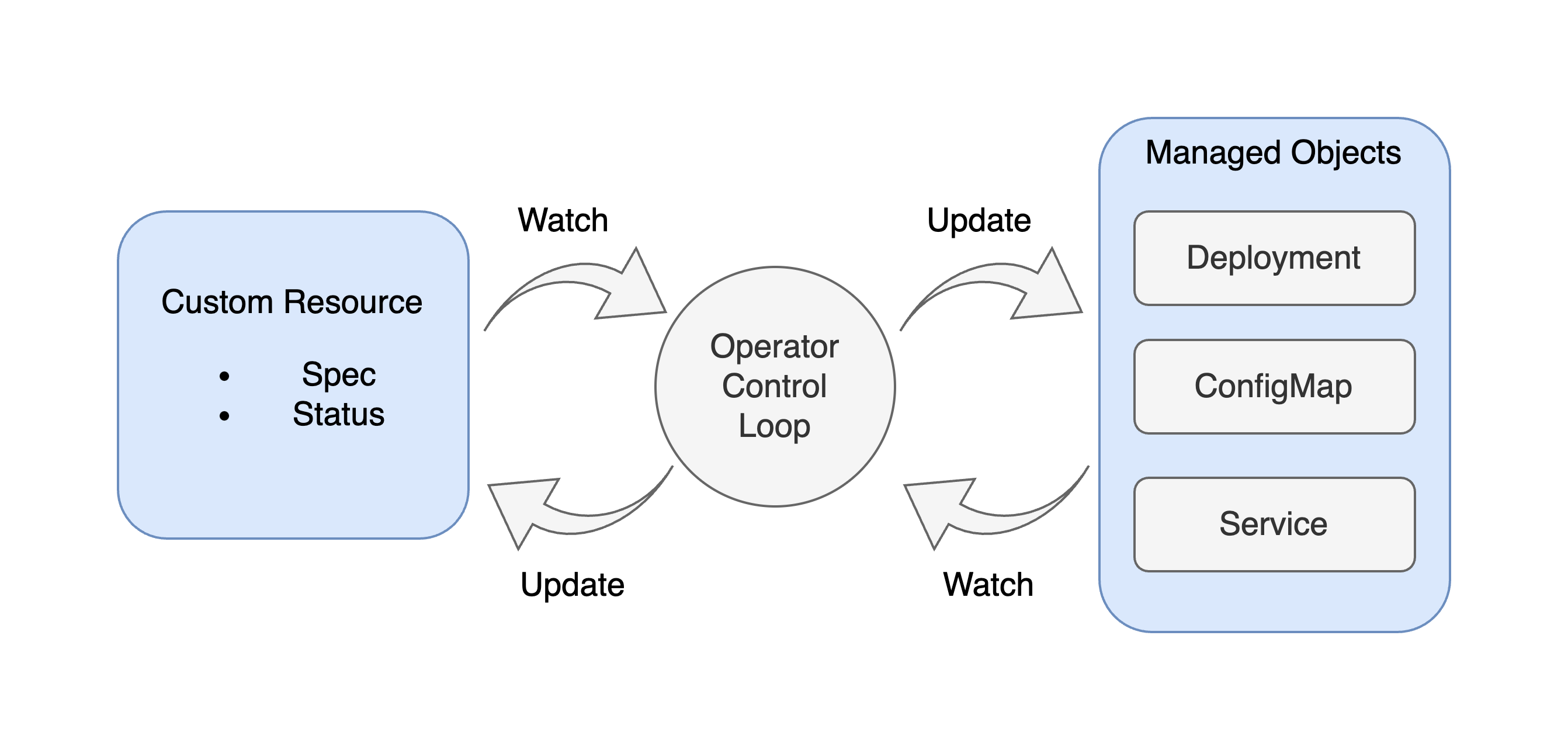
Custom Resource contains:
- Spec
- Status
Operator control loop watches the resource.
Operator updates managed objects such as:
- Deployments
- ConfigMaps
- Services
Changes are observed and reconciled continuously to maintain the desired state.